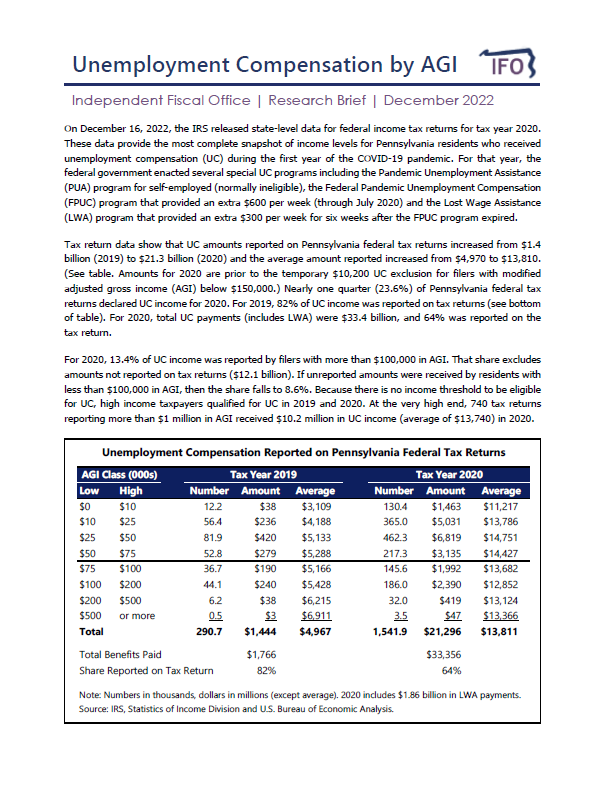
The IFO published a research brief that uses the latest federal tax return data to provide a breakdown by income class for unemployment compensation (UC) benefits received by Pennsylvania residents in 2019 and 2020. For 2020, residents received $33.4 billion of UC income and $21.3 billion (64%) was reported on the federal tax return. For amounts reported, $2.9 billion (13.4%) was reported by filers with more than $100,000 of adjusted gross income (AGI). High income taxpayers qualify for UC benefits because the federal program does not apply income thresholds.
Tags: brief, compensation, research, unemployment
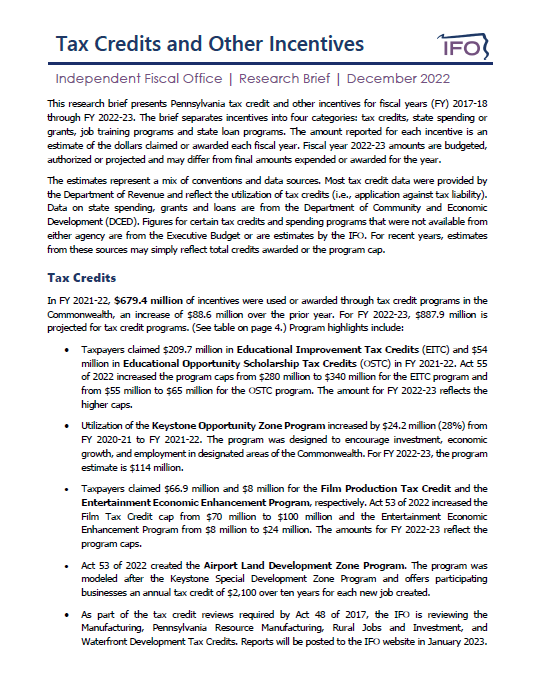
This research brief presents data on Pennsylvania tax credits and economic development incentives for fiscal years (FY) 2017-18 through FY 2022-23. The tables provide annual detail on tax credit utilization or awards, state spending or grants, job training programs and state loan programs. Fiscal year 2022-23 amounts are budgeted, authorized or projected and may differ from final amounts expended or awarded for the year. The brief also highlights recent changes to incentive program spending or utilization.
This research brief was reposted on December 21 to correct a text error on page 1.
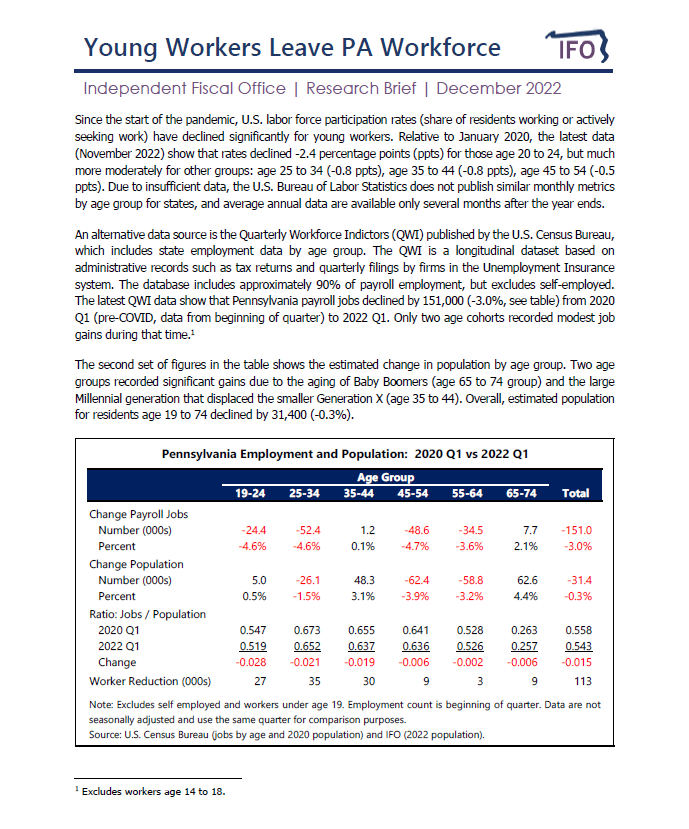
The IFO published a new research brief that examines the age composition of the PA workforce using the latest data from the U.S. Census Bureau. Since the onset of the pandemic, the data show significant reductions in workforce participation rates for workers under age 35. Workforce participation rates declined for older workers too, but contractions were notably more moderate.
Michaela Miller gave a brief presentation at the FTA Revenue Estimation and Tax Research Conference on evaluating the effectiveness of tax incentives without ROI. The REAP tax credit was used as a case study.
Tags: incentives, roi, tax
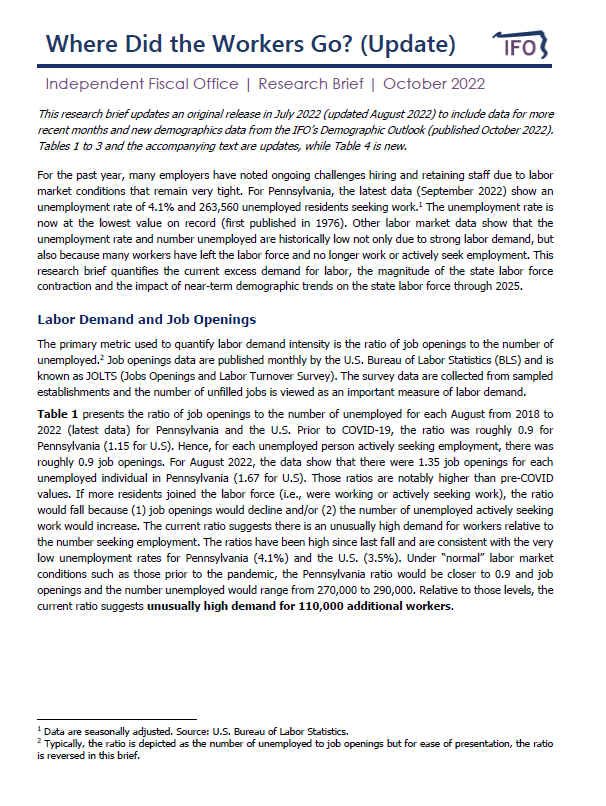
This research brief updates a prior release in August 2022 to show data for more recent months and new demographic projections from the IFO’s Demographic Outlook report.
The IFO published a research brief that examines the factors that caused the PA labor force to contract by 120,000 workers since the start of the pandemic. The updated research brief focuses on the interaction between recent and projected demographic trends and the contraction of the state labor force.
Tags: brief, demographics, labor, research
Section 604-B (a)(2) of the Administrative Code of 1929 specifies that the Independent Fiscal Office (IFO) shall “provide an assessment of the state’s current fiscal condition and a projection of what the fiscal condition will be during the next five years. The assessment shall take into account the state of the economy, demographics, revenues and expenditures.” This report fulfills the demographics obligation for the IFO’s release of the Economic and Budget Outlook for Fiscal Years 2022-23 to 2027-28.
Tags: demographic, demographics, outlook
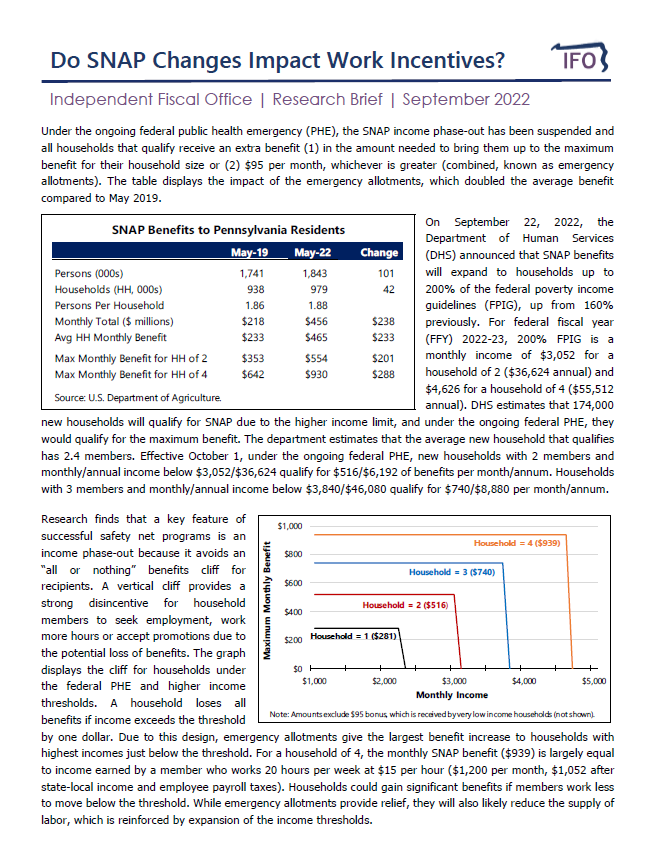
A new IFO research brief examines the impact on SNAP benefits from the ongoing public health emergency that eliminates the income phase-out and the recent expansion of income thresholds from 160% to 200% of federal poverty income guidelines (FPIG). Due to the elimination of the income phase-out, recipients face a vertical all-or-nothing benefits cliff. Research finds that vertical cliffs provide strong disincentives.
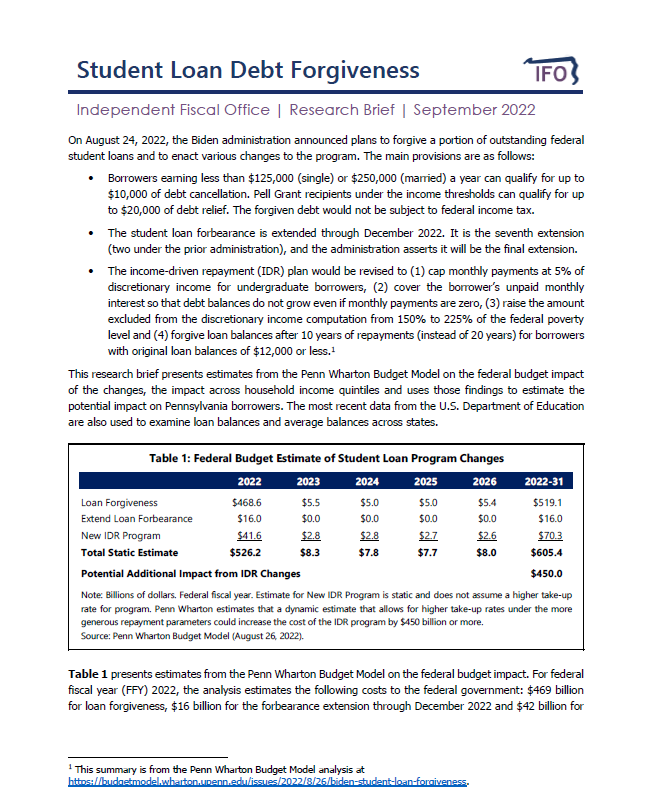
The IFO published a research brief that uses a national analysis from the Penn Wharton Budget Model and data from the U.S. Department of Education to estimate the impact on Pennsylvania borrowers from student loan debt relief and other proposed changes to the federal program.
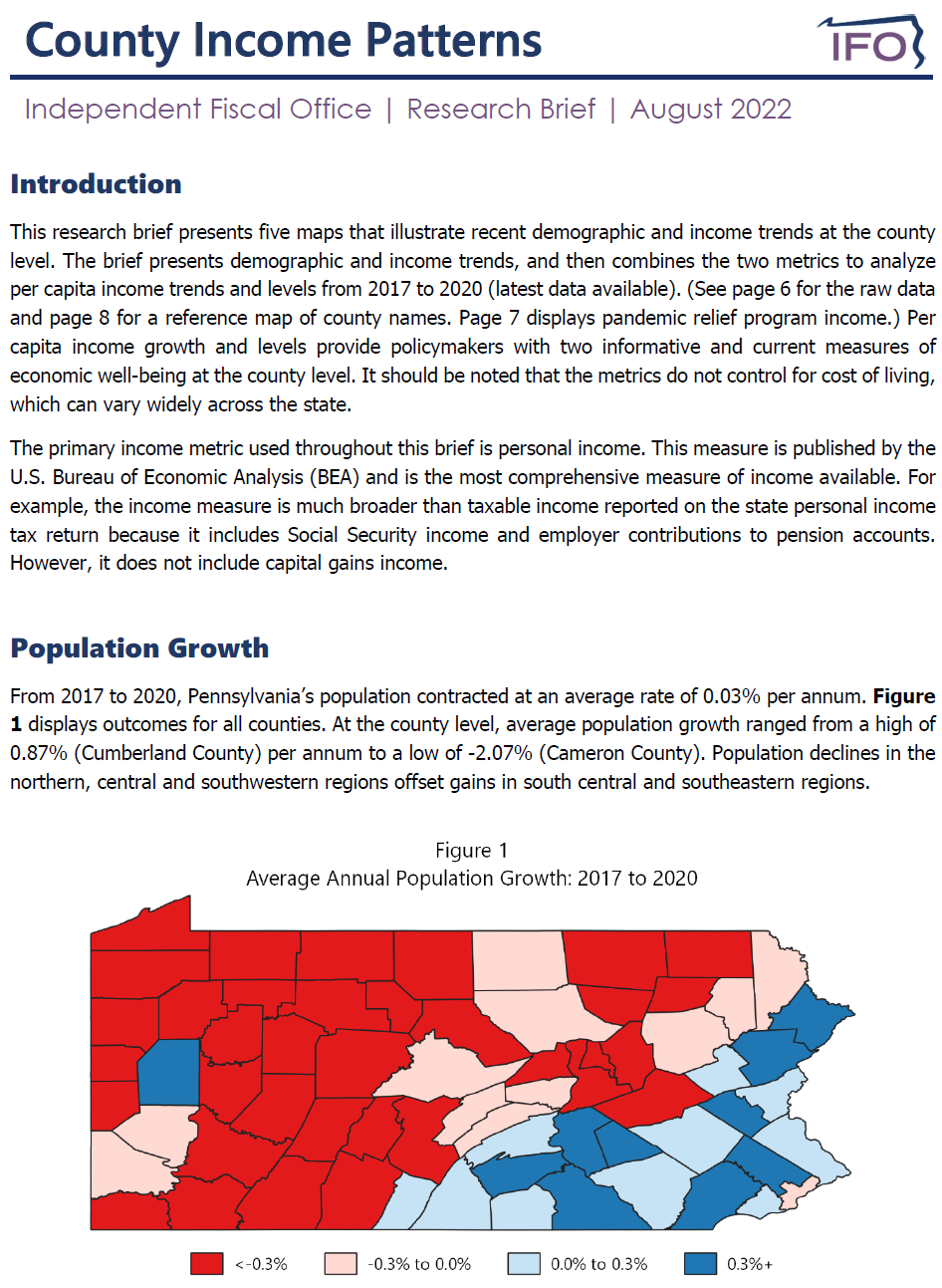
This research brief uses the latest published data to generate maps and county rankings of recent demographic and income trends. The release highlights population change, personal income growth and per capita amounts for all counties in the Commonwealth.
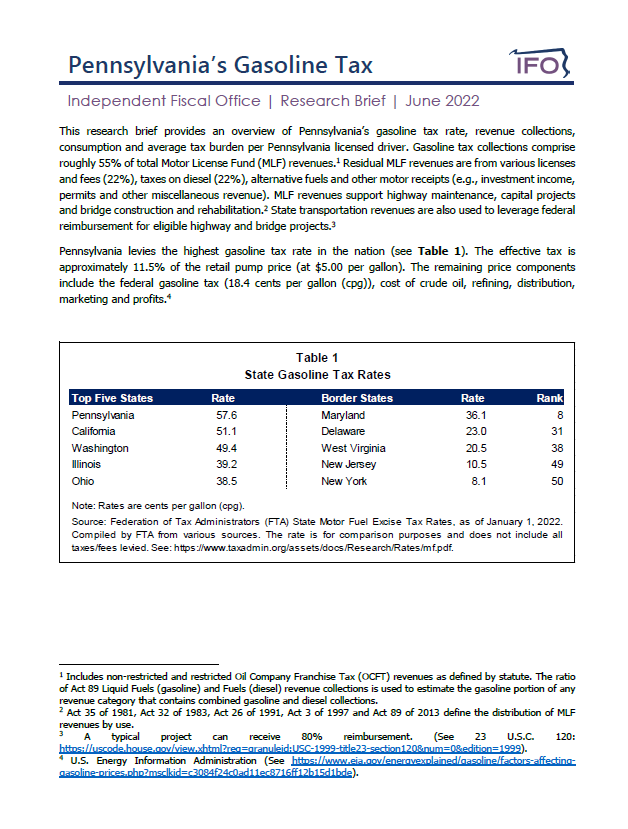
The IFO published a research brief that examines the Pennsylvania gasoline tax, which comprises 55% of Motor License Fund revenues. Although Pennsylvania levies the highest gasoline tax rate in the nation, the analysis finds that collections have not kept pace with the rising cost of road construction. This outcome is largely the result of the tax structure, which is tied to the average wholesale price of fuel and has not increased since 2018. For FY 2021-22, the IFO estimates that the annual gasoline tax burden per licensed Pennsylvania driver is $285.